
Lunenburg Awaits!


I had a real adventure in Lunenburg Nova Scotia at the end of September. I went there to teach a workshop for the Lunenburg Art Association & Gallery. As I planned for this workshop, I was excited that I had a full class and I was looking forward to getting back to Nova Scotia. Pam and I spent part of our honeymoon there 11 years ago. Originally, she intended to go with me on this trip, but we also thought she would have a new kidney. Unfortunately, due to health insurance restrictions, traveling out of the country isn't possible for her at this time.

Interestingly enough, there were many little twists and turns to this trip across the border that made it quite the adventure. It all began with a leaky sunroof that I had tried to fix on my own in August. It seemed to all be fine until we had inches upon inches of rain with storm after storm and I had to start throwing a tarp over it in the driveway or else it would quickly become a Ford Escape with its own swimming pool. The rain stopped just long enough before I left for another attempt at solving the dilemma. The forecast called for lots of rain heading up north into Maine and then clear blue skies during the workshop week in Lunenburg. My last minute, 'what-the-heck...why not' idea was duct tape. I covered the sunroof edges with duct tape and I laughed at myself for even thinking this would work. The day I loaded up the car, there was no rain. None. That is, not until I left the driveway. Ten minutes on the road and the skies opened up like a water faucet. I glanced up at the corner of the sun roof where water usually pours in. Nothing.

I had given myself plenty of time to get up to Calais Maine on the Canadian border. It was a nine hour drive and it took me four hours to get to Wells Maine which usually only takes three. I stopped in Wells and called it a day. It was 10 PM. Driving in a pouring rain at night was making my head pound. There was still no leaking from my sunroof and the duct tape was holding surprisingly well. The next day I drove to Calais Maine. It rained on and off throughout the drive but at least it was daylight. I was excited to get to the border and I took a room at a small hotel. There was nothing of note in Calais except I was happy to have a decent room with a nice comfy bed and I caught up on some much needed sleep. The next morning I envisioned  driving across the border, then driving an hour or so to St John and taking the car ferry over the Bay of Fundy to Nova Scotia.

At 6:30AM the next morning, I pulled up to the Canadian Border. The conversation with the officer at the booth went something like this.

Border Officer: 'What brings you to Canada?'
Me: I am doing some painting and teaching a workshop.

Border Officer: 'Do you have a Letter of Invitation to come to Canada to teach this workshop?'
Me: 'No. What is that?!'

Border Officer: 'Do you have a Work Permit in order to come to Canada to teach this workshop?'
Me: 'No. What is that?!

Border Officer: 'Did the place where you will be teaching this workshop fill out a Labor Market Survey explaining why you need to come to Canada to teach this workshop instead of another Canadian?'
Me: 'NO AGAIN. What is that??!!! ##%^%$*

This had not gone quite as planned.! An hour and a half later, after spending what seemed like eternity explaining to the Immigration Officers 'WHY' I was trying to enter into Canada, I was signing a document stating that I would leave Canada 'Post Haste' and I was told not to return without the proper documents.

I am telling you this because, you should understand that crossing the border is not as easy as it once was. Before 9/11, I can remember driving into Canada looking for painting spots with George Carpenter and several cars of painters, only to NOT find what it was we were looking for and so back out we went. Then into Canada again at another crossing and back out etc etc. We did this 5 times or so. I doubt it would have been this easy if we were to try this stunt today.

So according to Canada, I was technically entering their country to 'work'. This was the major factor to my problem. The good folks in Lunenburg did not explain this paperwork and proper document information to me because some laws had recently changed and they did not know about them. They've had artists come in to teach for years without this paperwork. Back in my hotel room in Calais I explained all of this to them and they worked at getting what was needed for me to enter. In the end, I did indeed need a Letter of Invitation, but as a workshop or seminar (key word -seminar) instructor, guest lecturer and/or performing artist, I did not need a 'Work Permit' nor did the Art Association need to fill out the 'Labor Market Survey'. They faxed me the info as stated by law about teaching a seminar, lecturer or performing artist and I brought it with me the next morning back to the same border crossing. This time around, I was only there for maybe 15 minutes while the Immigration Officer went through some of his books and stared at my 'Letter of Invitation' for awhile. Finally he stamped my passport and I was welcomed into Canada and told to enjoy my visit. Yay.

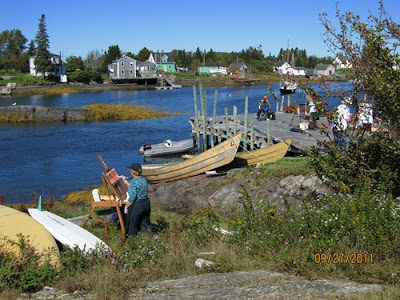
Before this week is over, I will post part 2 of this workshop adventure.  It was a great group of students and there is much more to tell! I'll post some demo pics too. Here are a couple images of painting spots.


Autumn Workshop


I've recently returned from an interesting and fantastic trip to Nova Scotia. I am in the process of writing about that experience and it will become my next post. This past weekend, I taught a plein air workshop in my hometown of Woodstock CT and I want to write about it today.

This workshop is an annual one to paint the Autumn color. This year, apparently due to Hurricane Irene dropping a ton of rain on us, which had a lot of salt in it from the ocean, the color is not as spectacular as I had hoped for. As a painter though, I am not really interested in a cacophony of bright colors all competing for a place on the canvas. A little bit of intense color goes a long way. We as painters, have the opportunity to tone down the color a bit to create harmony and we can brighten color where it is needed to help to create a focal point. If a painting is all full of bright color, nothing gets heard over all that loud noise. A canvas like this is hard to look at. For the person who is taking a scenic drive or walk, the bright colors can be cheerful and fun to take in. Hand that same viewer a painting done of this same scene done verbatim and he won't feel the same about it.

Harry Ballinger said in his landscape book that the peak of Autumn harmonized better when painted on an overcast day or could be better unified when painted in a back-lit situation. These are excellent points to consider. I personally prefer to paint the early Autumn color or late Autumn when the trees have lost a lot of their leaves and I can see through the foliage. A scene like this attracts me because their is still some bit of Autumn color that plays off the beautiful purple tones that make up the distance.

This was a three day workshop. Students were given the option of participating  for one, two or all three days. Everyone liked having these options and I am considering doing more of this. I would love to hear feedback. It appears that everyone has such busy lives these days and although someone may want to register, they can't always make the commitment for the full number of days. Students who came for just one day of this Autumn Workshop were very pleased with this option and confided that they got a lot out of the one day. One student said that she was taking home a lot of new ideas.

On the first day we had an extremely rainy day and I brought everyone into the studio for the day. This makes the most sense on a day like this. There are plenty of points to discuss about the painting process and an indoor demo is always well received by students. I chose a photo reference of a complicated scene that had a lot of potential for a good painting but needed some thought behind the final idea. I am reminded about a James Whistler quote: "To say to the painter that Nature is to be taken as she is, is to say to the player that he may sit on the piano!"

In the name of 'simplicity' I made some changes as I composed the painting. As part of the 'less is more' belief system that I have, it is my sincere hope to get at something in the simplifying of a subject that will say and feel more about that subject than the subject itself. It doesn't always happen, but when it does it is special. It's why I paint. Here is another quote, this time by Thomas Eakins: 'In mathematics the complicated things are reduced to simple things. So it is in painting.' And Albert Einstein said, 'Out of clutter, find simplicity'. And the kicker of them all is this one, also by Einstein: 'Everything should be made as simple as possible, but not one bit simpler.' Eureka! Now THAT is what painting is all about!

I'm putting up some images of the indoor demo and also one of the outdoor demos. In the first demo you can easily see the changes compared to the photo reference. I played up the size of the larger building and played down the size of the barn to the left. I did this for the sake of balance. If things are too similar in size, they cancel each other out. The big describes the small and the small describes the big. Emile Gruppe was a master of this idea. I avoided some of the clutter of the hodgepodge of trees to the right and gave the viewer some room to see beyond. I exaggerated the angle of the shadow to the left and also the dark shape near the stone wall, all for the sake of getting the viewer into the picture. I toned the linen canvas with raw sienna and then I blocked in the painting with raw sienna and a hint of purple. I wanted to show the relationship of the big shapes and to strike a well composed balance with my dark and light pattern. This my 'big idea'. I always think about someone saying..Hey! What's the big idea? ..The big idea in a painting is what makes the painting work. It holds it all together.


Here is an outdoor demo that I painted on Sunday morning. This was a quick one and I really stressed the importance of the big relationships.


The Maine Experience - Part 2


I have been travelling for weeks, teaching and painting in Maine and in Canada. I've had no real access to the Internet, so my idea of keeping up with my blog in real time has just been impossible. I apologize for such a delay in posting, and now plan to get caught up and post on a regular basis again. Thanks for being patient with my travels!

Here is part two of my painting trip to Stonington Maine. It includes good info about making the most of a painting trip and I hope you find it useful.

Pacing myself on any painting trip is important. I think there is a logical rhythm to it that if adhered to will make for a successful time. I used to go on painting trips and try to paint EVERYTHING. Then after a few days, I was exhausted and would find later that I could have done better if I had slowed down the pace and had spent the time to think more about my subject matter. In the book, A Sense of Place: The Artist And The American Land, by Alan Gussow, there are wonderful essays that explore the complex relationship between the artist and the landscape. I highly recommend this book as a way to understand how important it is to connect with whatever it is you are painting.

Here is a link.  http://www.amazon.com/Sense-Place-Artist-American-Land/dp/1559635681

For me on this trip to Deer Isle, I arrived late on a Monday night after an 8 hour drive. I had six full days to get work done. I had to talk to myself and resist the urge to jump out of bed that first morning and attempt to  try and paint everything and anything under the sun. I have learned to pay particular attention to spending some time just looking and thinking before diving into painting. Armed with a decent digital camera and a sketch book, I like to rise early and spend time photographing and making thumbnail drawings of what I am seeing. It is all part of becoming familiar with a place. Doing this, I get a sense in this particular case about how really big this harbor is and how many boats are always coming and going. I learn that the lobster boats head out about 4:30 A.M. and start returning to unload their catch around 11:30 A.M. This goes on all day until around 5 or 6 P.M. Lobster boats return and unload at 4 different docks. As the day goes on, it becomes a real dance. One boat comes in, while several others weave and bob while waiting their turn and so on. After they unload, the lobstermen head back to their mooring spot to tie up their boat and then come back in on their skiffs. It all becomes part of the big dance. On the docks, several men are helping to unload the catch. Here is a picture that I think will help get the point across about how dance-like this all is.


All the while, I am snapping picture after picture and making some quick drawings. I'm excited by all that I am seeing and I really can't wait to paint. All day long I have painted numerous ideas in my mind. Seeing a painting in your minds eye is half the battle and can produce some well executed paintings. I'm like a hunter/gatherer. I want to come home with some good paintings but I also want many more ideas for future paintings that can be worked on later on in the studio.

On this trip I had a weather forecast that called for an entire week of sunny weather. The tides were also in my favor and my trip was planned with the tide charts in mind. I want to paint the docks and the boats when the tide is at it's lowest or at least somewhere inbetween low and high tide. Painting at the highest tide would be of importance if my goal was to paint surf, but for this subject matter, painting it at high tide would not excite me. All week long, I had a low tide in the early morning and then again in the late afternoon or very early evening. It was picture perfect.

With that being said, let me reiterate a point here. I came home with many paintings. I came back with numerous drawings and a lot of photo references, but I mostly came back with IDEAS. Now I am looking forward to spending the time to paint a cohesive body of solid work from what I've done out there.

George Carpenter used to tell me that I should hold onto more of my outdoor work in order to make more and better work from them. Especially with the idea of going bigger. This is precisely what I am doing more and more of. I spend about half my week painting outside and the other half hunkered down in my studio.

Here are a few of the quick paintings I did on location. These images will give you an idea of the varied subject matter and the feel of Stonington Maine.