The Process of Doing
My latest weekend workshop here in my studio was titled simply 'Composition'. When we think about 'one word' definitions for the word and what it really means for the painter, we generally come up with things like 'structure', 'design', 'placement', 'organization'. When I asked my students what words came to their mind, these were their answers.
When I looked up the actual definition of the word, the dictionary tells us that for an artist, the word 'composition' means, the act of combining parts or elements to form a whole. This lead me to looking up the word 'act', which said simply, the process of doing. Then I looked up the word 'process' and found this definition. A systematic series of actions directed to some end. And the word 'system' stated that it was an
assemblage
or
combination
of
things
or
parts
forming
a
complex
or
unitary
whole.
It gets pretty interesting playing this word game.
So here's my point. A good composition for an artist requires somewhat of a systematic approach to the planning of it. And here's another point. Generally when you mention the word 'systematic' to a painter, their face scrunches up and they want to run away from the very thought of the idea! They think that using any type of 'system' will surely squelch their creative self. I'm more in line to believe that using this approach actually opens up the mind to being more creative and affords the painter with an opportunity to see things in new ways and to be inventive and clever. The 'process of doing' can be fun!
In my workshop, we looked at dozens of well composed landscape paintings by artists like Emile Gruppe, Aldro Hibbard, Paul Strisik, Carl Peters, Anthony Thieme, John Folinsbee, Harry Leith Ross, Edgar Payne and more. What becomes apparent when you look at the work by these painters, is that while they were alive and working, every one of them put an effort into making compositions that were strong. They didn't just make an okay plan, they used their brain and they made an exceptional one!
Herein lies a question that we as painters have to ask ourselves... ...Am I really planning my compositions or just kind of winging it??? and... Did I answer that question honestly or not !!!
These painters made use of the 'Steelyard' idea. They made use of the 'L', the 'S' and the 'C'. They made 'Circular' compositions, they made 'Radial' compositions, they used 'Pattern' and 'Repeating Shapes', the '3 Spot', and 'Alternating Bands'. They composed within a 'Triangle', they thought about the 'Tunnel', the 'Group Mass', the 'Cross' and more. In their paintings, they looked at the subject and arranged elements with one of these compositional ideas as a main plan and also made use of other ideas within that main idea to make a more complex one.
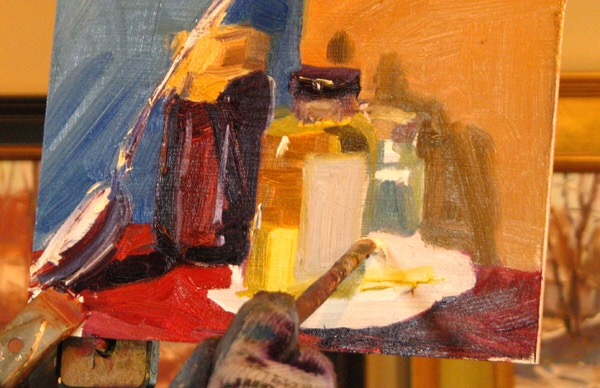
The participants in this workshop have also been attending my wife Pam's Monday morning painting class. They have been working on painting from the still life. This afforded me the opportunity to gear the workshop towards both still-life and landscape composition. For Saturday morning, along with looking at strong compositions and talking about them, I took 3 found objects and composed and drew the elements into different types of compositional ideas so that they could see the process firsthand. When I say 'found' objects, I really mean just that. I got the idea of having them first see the compositional ideas thought-out with still life objects, at the start of the workshop when I realized they were all in the Monday morning class. I went into the kitchen and grabbed three items of different shapes and sizes. In this case, it was a bunch of bananas, a coffee cup and a bottle of ibuprofen!
Here is what I did.


This next image shows my thought process of trying to make a strong composition from the photo. If I was on site I would put these ideas down in a sketch book and work from the best one. Outside, I will usually make 4 to 6 small rectangles in a sketch book and write down different compositional names under each rectangle and see if I can make the subject fit into each particular format. Doing this opens up the mind to many possibilities and keeps me from getting stale or making the same type of composition over and over again.

I decided on painting the diagonal composition for my 30 minute demo on Sunday morning. When I was first doing the thumbnail sketches above, it was difficult trying to fit this subject into a steelyard composition but it worked out well and would have made a good composition for a painting. The Radial design would have worked too. The diagonal won out in the end. I really liked the simple movement of it.

In my next post, I will show examples of the different painters we looked at for our slideshow.
White Goes Back!
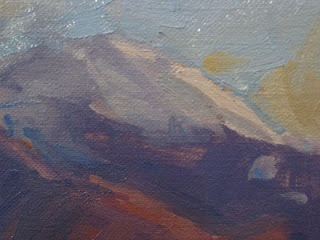
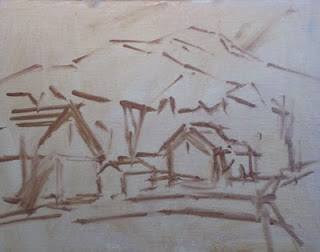
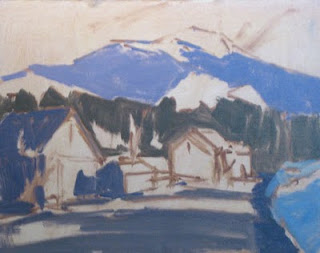
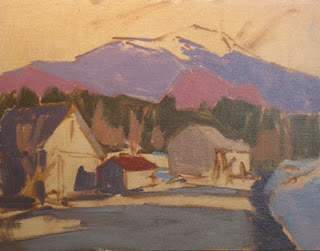
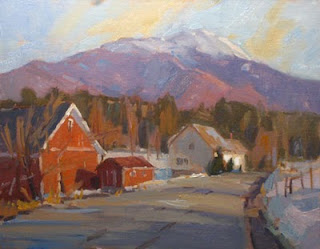
As promised, here is another quick post to go along with my recent Winter workshop. For my second demo on day two, I picked a photograph of Pleasant Valley Road in Jeffersonville Vermont. This is a spot that never ceases to amaze my senses. The late afternoon light will make Mount Mansfield glow. I've never been able to get something down on the canvas that late in the day that I've been completely happy with. Here is Pleasant Valley a bit earlier in the afternoon with Mount Mansfield in the background looking as majestic as always.
Notice that there is a lot of White in this painting. By white I mean, a white house, white trim on the barn and lots of white snow. White that is right out of the tube is always a big no-no for winter painting because snow is always absorbing the color of the bright sun or reflecting sky color or other colors from objects in the landscape. Because snow is wet, it tends to absorb and reflect at the same time. This is especially true of snow that is on the ground plane.
We know that dark objects will get lighter, greyer and bluer as they recede. This is an important observation of atmospheric perspective. Middle value objects tend to stay about the same, but light objects tend to get darker as they recede into the distance.
Snow that is in sunlight will get slightly darker and warmer as it recedes. If you look at the pictures I've posted of the snow in sunlight on the mountain, you can see this transition taking place. If we want the white to go back, we know that we can't make it lighter than white and it stands to reason that if it goes back blue, we won't get the feeling that the snow is being lit by sunlight if both snow in light and snow in shadow goes to blue. So...warmer and greyer makes sense here. In theory, this is a simple concept but to really make it happen on the canvas in a convincing manner is something altogether different. Practice makes perfect!
My next post will be about my 'composition' workshop that I've just finished up with a great group of students.
Comforts of the Studio
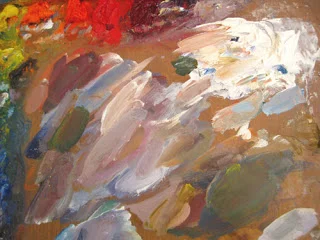
This past weekend I taught my annual Winter workshop in my studio here in Woodstock Connecticut. The weekend was all about Winter painting, particularly how light behaves outdoors with snow on the ground. Winter sings its own song and it's a beautiful one. If you learn how to approach it with some knowledge, it will help a great deal when you go out there to paint the subject plein air. In the studio, everyone can relax in a comfortable environment which is more conducive to learning and asking questions.
For many years, I taught this workshop outdoors. There is always plenty of die-hard painters wanting to brave the elements and of course, being out there is always an experience unto itself. The problem would come up when the weather forecast for the weekend would be brutally cold and windy. That kind of environment just does not lend itself to much of a learning experience. The only learning you glean from this type of experience is that you shouldn't be out trying to paint in those extreme conditions
.
Even when it was not the coldest of days, there was always a mix of students. Some of them were willing to be outside no-matter-what and some would find that they got cold quickly because they didn't bring what was asked of them for proper clothing or they would forget something at home. I remember one particular weekend of extreme temperatures where I could barely think in a straight line. I was dressed with all the right layers but the conditions made it so that my whole body was extremely busy just trying to stay warm. The demo I did was lacking to say the least and nobody talked. We all just wondered what we were doing out there! During the course of the weekend, I watched easels blow over and got to experience several canvases soaring through the air at the same time. It was like some type of interesting performance art or maybe more like a bad dream that I wanted to wake from!
Suffice it to say that I think the indoor Winter workshop is the perfect setting for learning. Everyone who attended the workshop this past weekend learned many things which they were able to apply to the paintings they worked on over the two day workshop. A lot of great questions came up and it was nice to be able to spend the time answering them, sometimes showing them by example. It was nice to be able to be in the moment instead of trying to answer them while simultaneously looking at fingers and ears that were clearly headed towards frost bite and wondering when I should call 911 !
On both mornings I talked about some specifics and then showed the students what I meant by painting a demonstration for them. I also showed them a digital slide show of winter paintings by many of my favorite snow painters. There were 156 images by Emile Gruppe, Lester Stevens, Carl Peters, Aldro Hibbard, Tommy Curtin and many more! We paused at several of them to talk about why the paintings worked and also to discuss value and color relationships etc.
One thing that I stressed to students is that regardless of whether you are painting on an overcast day or a day full of bright winter sun, your painting needs to have a certain amount of warmth to it. A painting that is full of blue is not going to read correctly and if the viewer is freezing just looking at it, you haven't done your job correctly. Sure, it's okay to have it feel like winter and give the viewer a sense of the cold, but there is always a certain amount of warmth in a winter painting that is needed in order for it to feel truthful. There is a great overuse of blue in many a snow painting.
You should be able to put a winter painting into a gold frame and have it feel right in that frame. There are occasions when a silver frame feels correct on a winter painting, but generally speaking they should be able to live in a gold one. One other point I stressed was that if snow shadows in sunlight lean towards blue, you cannot use the same blue in your sky and expect it to live and breathe correctly.
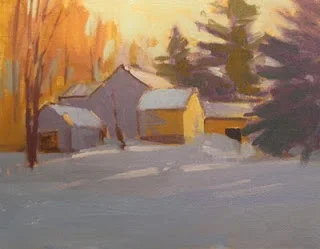
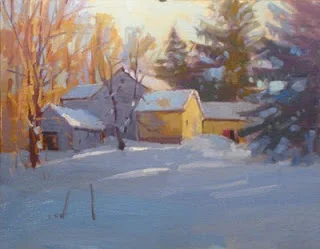
Here are a few images from my first demo along with a few close-ups. In a couple of days, I will post the Sunday demo along with a few ideas. The demo from Sunday was all about how to get snow to go back in the distance correctly, in this case all the way back to the top of a mountain!

My Painterly Approach

Welcome to 'My Painterly Approach'.
In this blog I post about my working methods. Whether I am painting in the studio or working outdoors en plein air, my approach to painting remains constant. I believe that the act of painting must come from the heart and be a spontaneous process. Painting can be summed up with this quote by master artist, teacher and author Charles Movalli. "It can't look like you've worked hard and long, even if you have. A painting should be done quickly with both your intellect and your nerves. When they give out, stop."