
Speeding at 35!


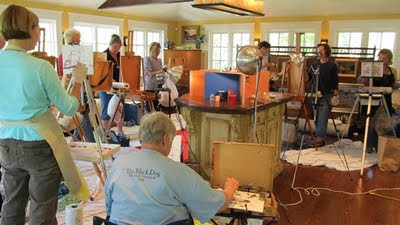
I recently gave a private weekend workshop in Gloucester Massachusetts for a wonderful group of dedicated painters. The workshop was titled 'Speed Painting' and basically everyone gets just thirty five minutes to work on 8"x10" panels! 

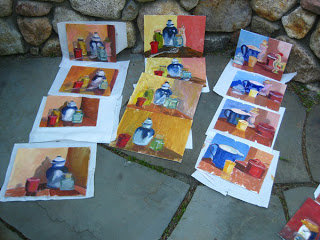
On day one, students work from small still-life objects and complete four or five of these panels.  The first painting is of three objects and with each new painting, another object gets added to the original three. For the last painting of the day, they are painting six objects. The objects are painted actual size and students work in groups of three or four to each set-up. I bring along about 100 small objects of varying size, shape and color with me to the workshop and put them out on a table so that there will be plenty of choices for arranging the still life set-ups.

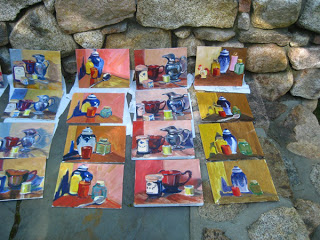
Here is the amazing thing that happens each and every time I teach this workshop. Everyone...and I do mean everyone improves throughout the day. The last painting with the most objects in it, turns out to be the best of the day. The pics that I include with this post will prove that point.

The idea of this workshop is to time each painting and as students work, I move around the room and help them think about how to work smarter. Obviously they have to paint much faster than what they feel comfortable with, but as they paint and repaint these objects, they begin to learn how to say more with less. There is no time to over think anything and so a more intuitive response is going to be generated. They have to draw the shapes quickly and block in the painting quickly. They have to think about how to say the most with each brushstroke.

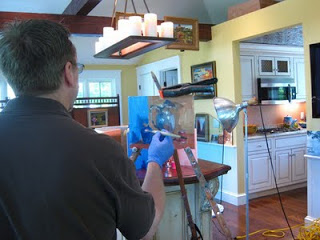
I demo for the first painting with 3 random objects of large, medium and small sizes. It helps everyone understand the process and they see that it can be done in 35 minutes. I tell them that the first painting will look as though they are just trying to cover the canvas in a small amount of time but as the day progresses, their paintings will get better. And even though we add an object each time, they will be able to handle the timing of it. There is a ton of nervous energy at the beginning of the day with this workshop, but as we get going, everyone begins to rework that energy into something positive and you can actually feel that shift of energy in the room!

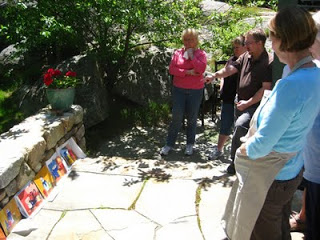
After each painting, we have a look at them as a group. Students put their just-completed painting next to their previous one and we compare. They get better each time.

I first learned speed painting when I was in art school. My teacher, Paul Lipp had us doing this. I was a pretty slow painter before speed painting and it helped me to think and work faster and smarter. It's not that I expect people to finish an 8x10 in 35 minutes during their normal painting time, but speed painting will help them work faster and to be more expressive with brushwork. There is nothing more deflating than going outdoors to paint plein air, only to have the sunlight and shadows change so much while you work that you have no idea what to do next. If you learn to paint faster and smarter, you will gain confidence outdoors and this won't be a problem.

The Rockport painter, Harry Ballinger once noted that at one point in his career, it would take him three hours to complete a painting and then one day he started to complete them in about two hours. He wondered what he had been doing during that extra hour. He figured that maybe he napped during it! And that's my point. We can get too comfortable and think and rethink our next move and that can actually hurt rather than help. Charles Movalli would always say, that a painter should work a little faster than what they feel is a comfortable speed. This keeps a fresh and spontaneous look.

On day two, we usually have the class work from the same general area outside and work on 8x10's with a 45 minute time limit. I've seen some amazing results from some of these quick speed paintings. I once had a group outside and the weather was changing and clouds were moving in. There was a highly dramatic moment that happened in the sky that lasted for about 3 minutes. Everybody got it! I was blown away and even slightly jealous that I didn't have my paints out to try and get that moment down too.

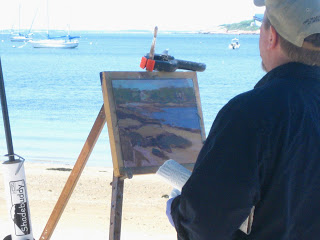
For this workshop, the participants wanted a slower pace for day two and we just painted outside for the day. I did a demo down on the beach first and then everyone painted on their own with help from myself and also from Pam. It was one of those spectacular 'almost summer' kind of days and everyone did really well. Two of the students had never painted outdoors before and they worked fast and efficiently out there and did really well! All of the participants for this workshop paint together once a week for the summer and I'm confident that they all learned some new skills and gained a new level of confidence to be more productive and proficient outdoors.



When It Waynes It Pours

Last week I participated in a plein air event in Wayne Pennsylvania. Now in it's 5th year, the Wayne Plein Air Festival continues to be run by an extremely committed group of people from the Wayne Art Center and gets better each year. The organizers of this event are generous with their time and they really get the job done. They put together a plein air event that starts off with a really fantastic kick-off gathering and ends with a gala reception that is out of this world. One of the things that they do very well is to work with each and every participating artist and their needs for the week. They provide host families for artists who are travelling from a distance and as usual my host family for this years event, Peter and Maria Archer were very warm and generous and made me feel right at home. At the culmination of it all, the Wayne Art Center does a terrific job of bringing together their community in support of the artists and their exhibiting work.


What set this years event apart from previous years was the rain. For some reason, Mother Nature decided this would be a very wet week and the weather report was calling for rain and thunderstorms for each and every day of the event! There seems to always be a day of rain or a morning of rain at some point during any plein air event, but the idea of dealing with potentially heavy rain each and every day  was a bit overwhelming. Overwhelming might not be the right word exactly, maybe it was more of a 'Do I really have to do this??!!'  mind-set. Every participating artist had to think and scheme of ways to protect their paint gear, paintings and also their bodies in order to immerse themselves into a week of plein air painting in the rain. When I read the weather reports each day leading up to the event, I knew that the ordinary plein air umbrella wasn't going to do the trick. I imagined myself being 'soggy' for an entire week and my mind went into action to correct this!


Over the past Winter, I had devised a set-up for my Gloucester Easel that would help to protect my paint box, brushes and my big piles of paint from snow crystals if I was painting when it was 'flurrying' or if I was painting under trees that were laden and dripping with melting snow. Snow and paint don't mix. If they do, you have a sticky gooey mess that does not make for good painting. My contraption was made out of cardboard with giant flaps that could be secured with bungee cords and I made some slotted vents with a utility knife in hopes that they would keep it from sailing away if a good breeze came up! It was heavily put together with duct tape too. It made my easel look something like an armored tank. It looked odd, but it worked. I felt slightly like I was using some good old Yankee Ingenuity, coupled with a desperate idea invented by a crazy artist in need of making paintings!


I brought this contraption with me to Wayne and I made sure I had plenty of extra bungee cords, duct tape and also one giant rain umbrella. The umbrella was dark green and almost black which was perfect for NOT getting bright colored reflected light bouncing around my painting panel. With all the rain in the forecast, I saw myself holding onto it with my left hand while I painted with my right. The armored rig would protect my gear and my umbrella would protect myself and my painting. If all this failed, I brought along a pochade box and figured I could paint from my car. Usually the problems that arise from doing this is that you are left with views that might not be your first choice to paint and also I find painting in a car to be just plain stifling.


The event was kicked-off with a pig roast inside a beautiful and enormous restored Pennsylvania barn and there was a live band too. Artists, event organizers and patrons gathered and we ate and drank and shared some good conversation and laughs. It is always great to see artists and other friends that you might not have seen since the previous years event. On this particular night, there was a murmur running through the crowd of 35 participating artists that was all about 'rain' and where to paint to get under cover etc. The big question of the night was...'Where are you going to paint tomorrow morning?' The forecast called for a 90 percent chance of rain over the course of the entire day.


On the next morning, my host family offered me breakfast and some espresso coffee made from a stove top espresso maker. 'OK! This IS going to be a great week!' I thought as I happily downed the coffee. I'm somewhat of a coffee fanatic. Dark roasted earthy coffee is my thing. At home and in my studio, workshop students will admit that my coffee is really good and we keep brewing it throughout the day!  It's not uncommon for me to make  cappuccino's or latte's for my students too.


A beautiful farm next door looked like it had lots of painting potential and my room mate and I got the grand tour from the owner and he very graciously gave us permission to paint on the property. It rained on and off during that first painting, but we both got a painting in. A Mama horse and her colt as well as the numerous goats on the farm, happily roamed about as we worked. My set-up worked quite well and I felt a little better knowing that I had completed my first painting.


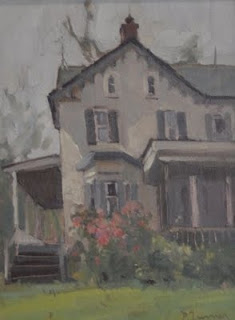
Over the course of the week, I would do two paintings of this farm. One would be of the farmhouse itself and it would get me the first place prize at the opening event! I painted several other paintings, scraped a few and in the end turned in a total of 8 paintings for the opening gala exhibition. For those readers looking for advice about painting overcast and diffused light, I think one of the most important things to keep in mind is this:


Overall, it is a cooler top light that your dealing with. Most students get into the mind-set that this means a very cold painting, but this is the wrong way of thinking. On this type of day, the light gets held up in the sky by the cloud cover, making it much warmer than perceived. Top planes receive the overall cool light but upright planes need to be painted much warmer than we think. So overall, to capture the feel of the day, we need to see the warmth and not make it so much about cold light. Vibration of warm against cool is important too. For a lot of my grays, I am putting down a warm note first and then running a cool note over it, letting some warmth come through. It becomes a push and pull of warm and cools with the overall feeling of the painting being a warm one. Nobody enjoys a painting that overemphasizes cold color. 

On one morning, I painted a view of my host families home which just begged to be painted upon my arrival and first view of it. It's the kind of old home that has a big history and now has some wonderful people making it their home. While I painted, the light would just start to break and I would feel the warmth of a bit of sunlight and the effect it plays on wet surfaces that want so much to dry. Then it would rain for awhile, but I tried to hold onto the light that I first saw and felt. Maria was working on a big art deadline and so I painted a  glowing light in the window which was her studio. They have the cutest dog; Tootsie, and I was imagining her running around the house while everyone was away for the day or possibly just curled up in her little bed by the doorway just waiting to bark and growl and scare away anyone or thing that came into the yard. It's things like this that find their way into a piece of work that cannot exactly be explained because it's more of something felt than seen, but it does somehow seem to change the piece and make it more personal.

I drove to several locations during the event and either painted there or moved on, and once, I drove past an intended painting spot and turned down a road just to turn myself around but found an amazing painting just waiting to happen. I love when this happens. I think I am part 'Plein Air Painter' and part 'Magellan The Explorer'. I like discovering new things! This painting was the first one of my paintings to sell on opening night. Also during the week I got to meet new people and made new friends and I got to have the most amazing home-made pizza at a little gathering put on by my host family. Good wine, good food, good conversation...all with great people. In some ways the painting time takes a back seat to the fun that can be shared with new friends at events like this!

A Drive to Maryland

A few weeks ago, Pam and I headed down to Snow Hill Maryland to participate in a two day plein air event and to teach a three day workshop for the Mid Atlantic Plein Air Painters. We had never really spent any time in Maryland and we were looking forward to it. After packing the car to be sure it would fit all the art gear plus all the medical supplies that go along with doing home dialysis, including the 70 lb dialysis machine itself, we were off.

Nine hours later we found ourselves turning left onto a dead end road that would take us to where our gracious host was putting us up for the week. It was midnight! We had our very own guest cottage and lights were left on for us so that we would know that we were in the right place. The cottage was absolutely beautiful and the scenery all around us was spectacular in the moonlight. We were on an ocean creek and even after a day of packing for three hours and driving for nine more, Pam and I were wide awake and trying to take everything in. For me, the coffee that I drank at 9:30 p.m. might have added to my awakened state!

I began to unload the car and unpack. I even lugged the 70 lb dialysis machine up the flight of stairs to the second floor bedroom by myself and began to set all the pieces together. We've been giving Pam home dialysis for over a year and a half now and we've traveled to many places with it. We even took it to Monhegan Island, which is 12 miles off the coast of Maine and isn't really set up for any emergency situations. There is no doctor and any real emergency would mean getting a helicopter in to airlift you to a hospital but we tried not to think about that. There is really no need to think that a 'situation' would arise and we just did our thing and prayed that the island electricity which was in the habit of going off almost everyday for a short period of time, would not go out during our time of dialyzing Pam. It did! It went off the very first time I had just put her on the machine and so I did what is called an emergency rinseback and all was fine. After that, we had no more problems for the remainder of a two week period.

After the two weeks of dialyzing Pam on that little tiny island, my confidence in handling the machine grew by leaps and bounds and so dialyzing her in Maryland wasn't much different than dialyzing her at home. AND..we had the coolest home for a week to stay in!

The 800lbs of dialyzing supplies that were shipped ahead were also waiting for us in the barn right next door to the guest cottage. Pre-mixed dialysate comes in bags which comes in boxes and when you go someplace for a week, it arrives ahead of you on a nice big pallett. At home, we can make dialysate from our own water source that goes through an elaborate filtration process and we can make enough for three days at a time. It takes a lot of work to travel with it, but AMAZINGLY, we CAN travel with it. Monhegan is Pam's favorite place of all to visit and paint and without this portable machine, she would not be able to get there. Nx Stage was not even an option until a few years ago when the system became available. For anybody reading this who gets hemo dialysis in a center or knows someone who does, you should look into Nx Stage. It is very gentle on the body and because of it, I got my wife back! The dialysis at the center is much harder on the body and when a patient is done being dialyzed the stress of it is like running a marathon and a half. No wonder Pam never had any energy after being dialyzed. The next day was always spent recuperating from dialysis and then the next day was dialysis again.

Dialysis is a part of our lives. It seems if I'm not wearing my painting hat, I am wearing a mask and exam gloves and playing the part of a dialysis technician. So it is was with our trip to Maryland. We taught all day and then would come home to our beautiful cottage, eat a quick dinner in between setting up the supplies and the dialysis machine and then we would spend the next few hours dialyzing. Then off to bed we'd go and get some sleep so we could wake up to start fresh with a new workshop day.

We dialyze Pam 5 or 6 nights per week and with everything involved, setting up, running her, taking her off, breaking down, monitoring and ordering and moving around supplies, it takes 25 to 30 hours of time.

So, I bring this all up because on this particular workshop trip, it was our last time of having to take the dialysis machine with us. Pam is scheduled for transplant surgery at the end of June and her daughter Heather is giving her a kidney! A little over one month later, we plan to be on Monhegan Island again. And we will get to enjoy the sunsets too!

Our workshop in Maryland was a fantastic time. We had a full class of great students who wanted to explore new ideas. We had pretty good weather too. Spring was in full bloom. How can I explain it any better than that. On Tuesday night, our night off from dialysis, we had a gathering at Bishop's Stock Art Gallery. Ann Coates was very generous with her time and allowed us to have a night of hanging out, drinking wine and playing some music. Gary Pendelton was kind enough to join Pam and I on the guitar and he did some great accompaniment on harmonica.  Someone else played some blues with Gary too. It was a good time.

It was a three day workshop and of course, as with all workshops, regardless of length, it went by too quickly. The main things I pushed during the three days was composition and a solid value plan. It's my belief that if a painter spends the time and makes a solid beginning, the painting can almost paint itself at that point.

After drawing in a solid composition and then massing in a strong value plan of lights and darks, Emile Gruppe would consider the painting finished. He would say that all the hard work was done and now anybody could come along and finish the thing!