The Seed of A Grand Idea
The Seed Of A Grand Idea
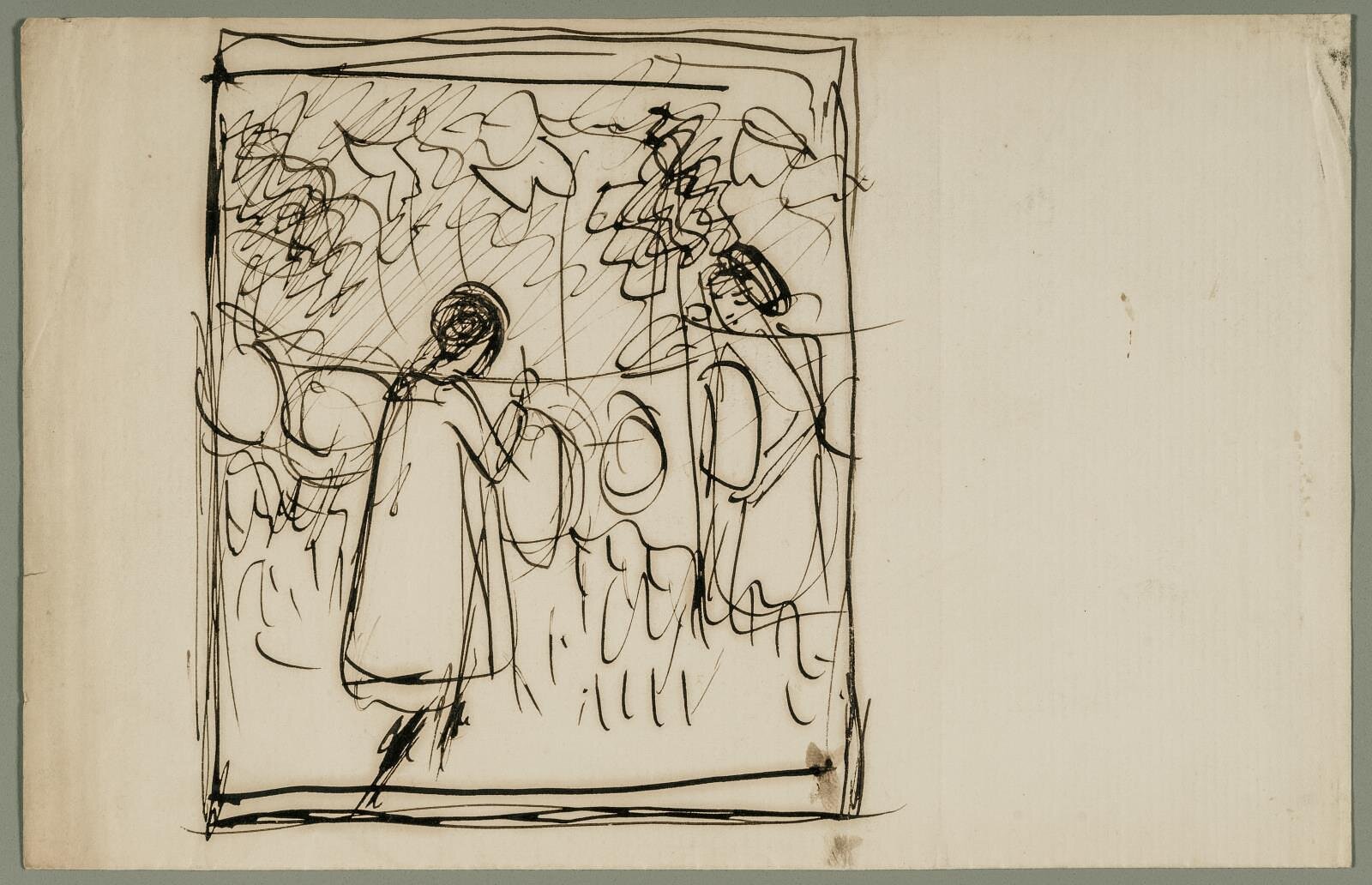
I've been thinking a lot about John Singer Sargent recently. While browsing through the collection of Sargent's work on the Museum of Fine Art, Boston MA, website; I came across this little drawing done by the masters hand.
This sketch, a quick doodle really, stands out in stark contrast against the many detailed drawings and sketches in the collection. Most of the drawings in the collection are studies for the Murals at the Boston Public Library that Sargent was commissioned for in 1856. It took Sargent 29 years to complete his 'Triumph of Religion' murals.
The Pen & Ink sketch is titled Sketch for Carnation Lily Lily Rose. It truly is the very seed of a grand idea. The completed oil painting is 5' 9" x 5' 1" and is in the collection of the Tate. I've posted an image of the painting at the top of this newsletter. After seeing this humble beginning of a masterpiece, I went to the Tate website and found this quick sketch which is a letter from Sargent to his sister Emily Sargent, with a compositional idea for Carnation Lily Lily Rose and also in the MFA collection.
Seeing these images got me asking the question: How often do people have ideas for big projects, whether it be for paintings or anything else, that never make it beyond this initial idea stage?
Sargent was struck with an idea and immediately, however vague the result, started to scribble it down on paper. It makes me think of what my parents used to say to me when I was tackling hard projects in school, 'The longest journey begins with a single step'. That first step is key. Then another step and then another. If we try to see it all completed before we have really begun, it can be overwhelming. Another way I have learned to look at projects is to imagine that all the steps that make up the project from start to finish have a weight of 10 lbs to them. Now imagine that a project with 12 steps weighs 120 lbs. Thinking about carrying all that weight at once is undoable. But thinking about and actually doing each step one at a time, means that you are carrying only 10lbs of weight at a time. Each time you complete a step, it no longer has any weight. A completed project has zero weight to it!
I'm working on a commission for a collector right now, and seeing Sargent's sketches has reconfirmed to me that an idea is a start and the simplest beginnings can become great achievements. I'm also working on a project involving online tutorials and some video work that will allow me to share my knowledge and passion of more than 30 years of painting, with everyone who is interested and wants to have a look. There are so many ideas that I can't wait to put together and share. I've spent a lot of time doodling and making sketches for my commission and I'm now in the 'finished' sketch phase. I've also been jotting down note after note for my online tutorial project since last October and slowly it's all starting to come together...step by step by step :)
If you want to view the collection of Sargent's work at the MFA and see more images of studies and sketches for Carnation Lily Lily Rose, as well as a very nice explanation of how the painting all came about, here are some links.
More about Carnation Lily Lily Rose here. The Sargent Collection at the MFA here.
Warm Regards,
David & Pam
All My Life's A Circle
All My Life's A Circle
Thank you everyone for your interest in and support of our art journey. You are all in our thoughts and prayers at this unprecedented historic time.
Pam and I are being responsible and practicing physical social isolation. With the present public health concerns, it's the civic thing to do. The New Hampshire Governor has implemented a stay at home order. But that doesn't mean we are living in fear and that we don't have hope. It simply means we are thinking about the health of others as well as ourselves as this situation unfolds. This is new territory for all of us.
New experiences can be good. In fact it's changing how we are presently thinking about our day to day plans and what that means moving forward. Just a few weeks ago, there were 10 of us artists painting in my studio, as part of our 'Art Circle' painting and critique group. We have postponed getting together physically, yet we saw an opportunity in this to keep the group together online. At a time like this, we adjust and we think it's important to keep painting and to keep finding inspiration and hope.
Our Art Circle Seacoast group is getting together weekly for critiques on the zoom app, which is free for our participants and easily downloadable in the app store and google play. We also have a private FaceBook page, where we can all post comments and photos. On Wednesdays, I give a thorough critique on each painting and offer ideas for improvements. Group members can offer other feedback and together we share a continued sense of community. I'm also making new mini lesson demo videos each week to share with the group.
We are now offering two more Art Circle options and we're excited to share them with you. No matter where you live, you can now become a part of our online community of artists who paint independently during the week and meet online through Zoom and FaceBook for critiques, camaraderie and inspiration. We will also be including the weekly mini lesson videos.The Zoom app is surprisingly effective at simulating a real life get together!
David Lussier's ART CIRCLE TOO is now forming and will meet Thursday's starting on April 9th. ART CIRCLE EVENINGS is also forming and will meet Wednesday evenings starting on April 8th. For more information and details about these online groups Click Here
We will be updating our scheduled activities and workshops and sending out a newsletter with that information soon. Please be safe and well.
Warm Regards,
David & Pam
P.S. The late great HARRY CHAPIN wrote the song 'All My Life's A Circle' Do you know it?
Some Reflecting
Some Reflecting
The start of a new year always gets one thinking ahead to new plans and new ideas. Pam and are excited for it all. Today I find myself thinking about where I am at this moment in my painting career and how I got here. Where would I be today without all the early instruction and guidance from my teachers at Paier College of Art ? (pronounced like the fruit)
Paul Lipp, is still painting and was valedictorian of his class at Paier. A former marine, he had a rigid disciplinary style and introduced me to oil painting. I had an early habit of leaving a lot of white showing through the canvas in all my paintings. I was clueless about the meeting of edges. Paul Lipp corrected that one very quickly.
Rudolph Zallinger, who could draw and paint the figure like there was no tomorrow, made you want to strive to learn anatomy. Zallinger painted the famous ‘Age of Reptiles’ mural for Yale University’s Peabody Museum of Natural History. The mural was 110 feet wide by 16 feet tall and took 10 years to complete. Rudy was a professor at Yale School of Fine Arts.
Dean Keller, made much sense of portraiture in the very short time he instructed our class and I quickly dove into the idea of becoming a portrait painter. Keller was a professor of art at Yale for 40 years and painted 160 portraits for the university. He also painted two presidents.
Joseph Funaro, who taught portraiture in my third and fourth year was a God send. A very disciplined and direct teacher, Funaro expected your best and he didn’t mince words when making a statement about what you had on your easel. In my third year at Paier, I developed a bit of an attitude towards art school in general and I was caught up too much in the social scene. I started to arrive late to Funaro’s morning portrait class and even missed a few altogether. One day he asked to see me after class and he basically told me that if I was going to be disrespectful by coming late or by missing classes, I shouldn’t bother coming at all. Ouch. Then I saw that he had pulled a few of my paintings from the storage racks and he proceeded to explain to me that he wouldn’t even bother with me, except that I had real potential. He pointed to a couple areas in my portraits and told me that they reminded him of Sargent. He encouraged me to buckle down and get to work. I was never late again to his class and it was the moment that I truly got serious about painting.
John Massimino is a skilled and prolific painter. He’s 92 years young and still going strong. I read an article about him giving a talk recently. As a teacher, Massimino would inspire you from the moment he opened his mouth. He had a way of speaking that was very animated with a lot of hand movements. Then he’d pause to look around the room in order to let his words sink in. On his face would be a grin that confirmed without a doubt, that he was passionate about what he was teaching. He made you feel like he was talking to you directly. He taught composition classes and to this day, I can hear his motivating talks and his unique way of getting his point across.
Robert Zappalorti is a photo realist painter. He paints trompe l’oeil and still life paintings that show a mastery of skill. He taught drawing at Paier and he was energetic and demanding in his approach. In my fourth year, one of our final drawing assignments in his class, was to take a Sears catalogue and choose a number of complicated items like a skill saw or power drill and draw them a bit larger than the image appeared and as exacting as possible. Then we had to turn these objects a quarter of a turn in our mind and draw them again from that imagined viewpoint. If that wasn’t already hard enough, we then had to turn them another quarter turn and draw them from this newly conceived angle. I think we had to do this with 8 items. He asked to keep mine as an example of getting it right for future classes to see. It was a great exercise!
Charles Sovek was a New York illustrator during his time teaching at Paier. He was a fun and energetic teacher who was always showing us new ways to approach things. He would bring in some of his illustrations, sometimes as they were being worked on and they were inspiring. His style at the time was realistic but in an illustrative and painterly way. I loved his classes even if he never pronounced my last name correctly. He was also working plein air on his own time and wrote his first book ‘Catching Light In Your Paintings’ while I was at school. A lot of the painting examples of figures in the book, came directly from his classes or from the painting time that he would generously spend with students after class. The models in the book are my fellow classmates. He also brought in the landscape paintings that were part of the book and he had a show of the in one of the galleries in the school. All of this planted a seed. Whenever I look at one of Sovek’s books on painting, I am right back at school like it was yesterday.
The photo realist painter of the highest caliber, Ken Davies was the dean of the school when I attended my four year program there. He was influential in helping me and other fellow students in our last year of the program to put together a rock solid portfolio. I was an illustration major and I would meet with him to discuss and plan each idea that I had. It was intense. I remember the discussions fondly. He has a brilliant mind. His advice was always carefully thought out and well intended. He wasn’t one of my instructors per say, but he did help me to build confidence and helped me realize that the portfolio I was building was unique and that my painting ability was strong.
Paier College of Art played a big part of who I am today. The four year program taught the principles needed In order to begin to really hone the craft of painting. It taught me that discipline was vital to success.
This month I was featured in Southwest Art’s online magazine with an article called My Process-My portfolio. I was interviewed by phone for just about one hours time. The resulting article is just a few paragraphs long with a few images to accompany it. Short and sweet.
Here is the link to the article.
My Process-My Portfolio
My Painterly Approach

Welcome to 'My Painterly Approach'.
In this blog I post about my working methods. Whether I am painting in the studio or working outdoors en plein air, my approach to painting remains constant. I believe that the act of painting must come from the heart and be a spontaneous process. Painting can be summed up with this quote by master artist, teacher and author Charles Movalli. "It can't look like you've worked hard and long, even if you have. A painting should be done quickly with both your intellect and your nerves. When they give out, stop."