 |
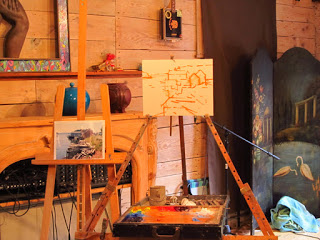
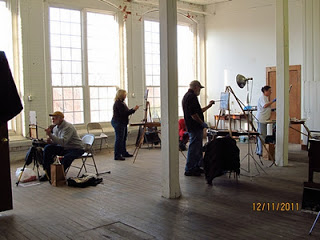
| A corner of the new 1400sq ft studio |
It's time for me to get caught up on my blog and then to keep it current! My schedule has been non-stop for weeks on end, but I do see light at the end of the tunnel. The end of each year has a way of making us feel 'stressed' with the chaos that ensnares us at holiday time, but I'm not going there. Seriously, I'm not going there. Here at home, we are doing Christmas and New Years in a very low key. It seems like a miracle that Christmas is nine days away and I'm feeling laid back and calm. I highly recommend this low key version of the holidays, but this is a painting blog and so I guess I should focus my thoughts on that!
At the end of my last post, I had just entered into Canada and was on my way to Lunenburg, Nova Scotia. I now had the option of taking a ferry from St. John's across the Bay of Fundy to Nova Scotia or I could drive the big loop around to Nova Scotia in my car. Originally, I had intended to do the ferry, but the timing of things had changed and I would have to wait several hours for the ferry, followed by the 3 hour trip across the bay, and then another 3 or 4 hours of driving before reaching my destination. I was staying with Fred and Patti Rhinelander and they lived in Blue Rocks, Nova Scotia. I figured that if I waited for the ferry, I would not arrive at their home until about 2 in the morning. By making the drive myself, I might get there by 10 or 11 PM. It was a no-brainer and I hopped onto the highway and started making the long drive.
It was an interesting journey. I had about thirty dollars in American money and I had done all the proper things in order to have my debit card work in Canada. The first time that I stopped into an Irvine station to fill up, my debit card worked just fine and I breathed a sigh of relief. The next time I used it, it wouldn't work. I tried an ATM and that didn't work either. To make a long story short; I put twenty five dollars worth of gas into my car with cash and prayed that I would make it to Nova Scotia. I had snacks in my car and they became my lunch and dinner. I attempted using the debit card a couple more times with no success. I missed a turn along the way and ended up very lost for awhile, but eventually I figured my way back to the proper highway and kept on going. I should mention that I have a GPS but it didn't recognize Canada at all.
Somewhere along the way, close to Lunenburg, I put my last five dollars into the gas tank and I safely arrived at the home of my host family somewhere between 11:00 and 11:30. It turned out that Pam had used my debit card account number from the United States right after I used the card to get gas at the Irvine station in Canada and so they flagged it. Once I solved that, I had no more problem with accessing money and putting gas in the car!
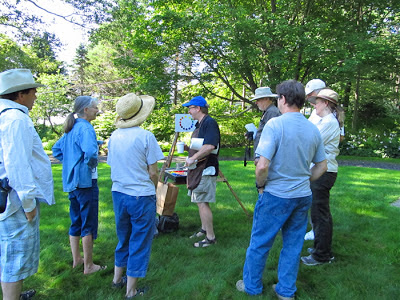
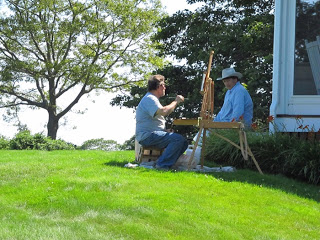
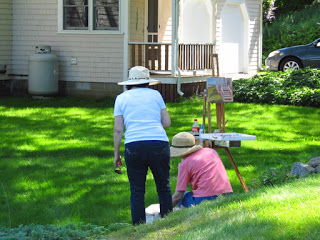
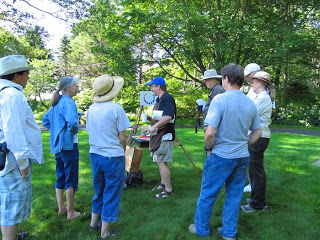
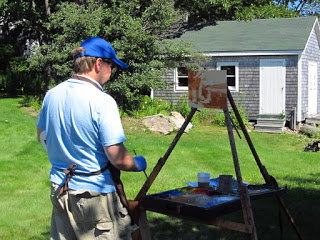
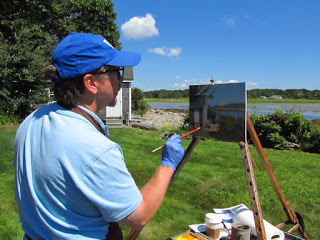
My host family was wonderful, the workshop week was wonderful. My students were great and the weather was absolutely perfect. I couldn't have asked for a more cordial and accommodating host family. I couldn't have asked for a better group of students. I wanted them to learn to work smarter in their planning stages in order to be more spontaneous in their painting approach and I stressed big shapes and big relationships over a bunch of detail that meant nothing. Each student made every effort to try my ideas and go well beyond their normal comfort level. Whatever craziness I had gone through to get to Lunenburg, it was all forgotten by the very first morning of the workshop.
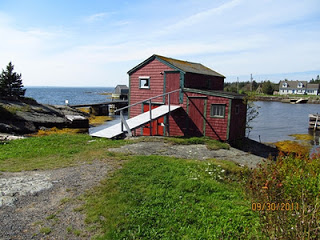 |
| This was even better at low tide! |
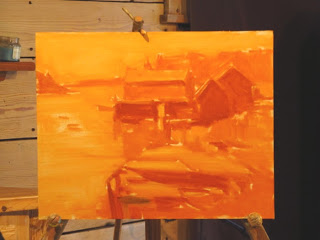
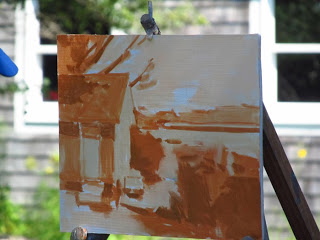
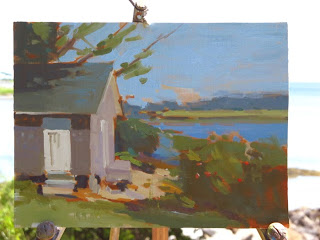
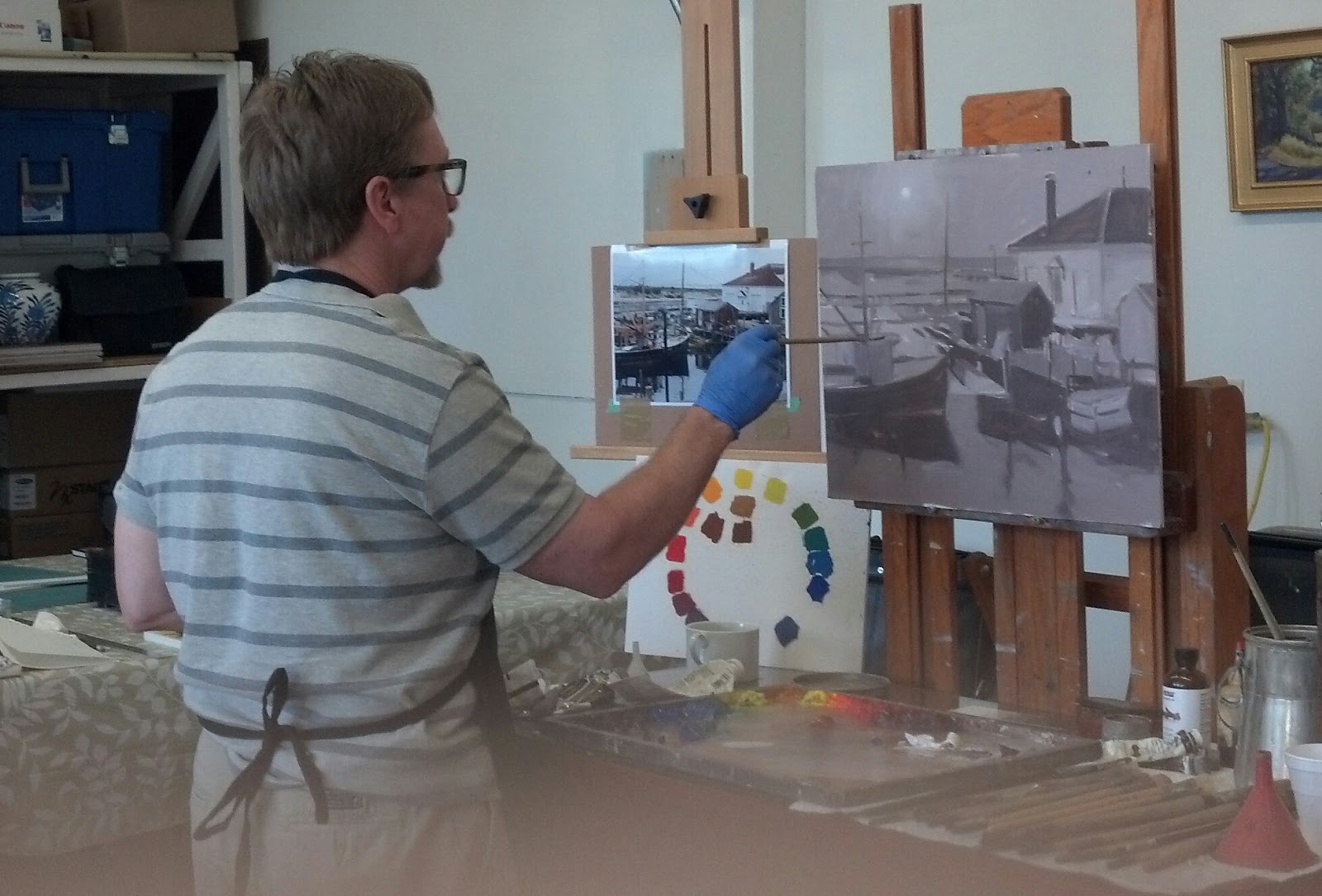
My demo's were done quickly and with a bit more spontaneity than I may normally go about , but this approach ALWAYS helps students to paint more intuitively and not labor over each stroke. Because I am painting very quickly, they open up to the idea that they can tackle a painting in this manner too. It is like giving them permission to loosen up. I didn't paint finished pieces in my demos but they could see how I constructed it, planned a composition and a dark pattern and then built it up from there. Many times students tend to paint 'things' and not shapes of color and value. The mind-set is that, this is one thing and this is another thing. They are not seeing the big picture or the 'big idea'. Charles Movalli says 'No Pattern, No Painting' and this is key. It is the relationship of lights and darks and the relationship between each different color shape, that turns 'THINGS' into a 'PAINTING'. I wanted them to use the subject matter, but to learn to say more with less.
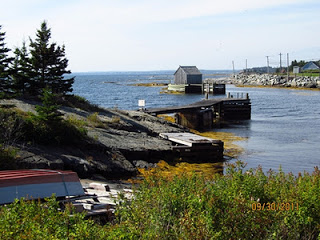 |
| A classic paintable view |
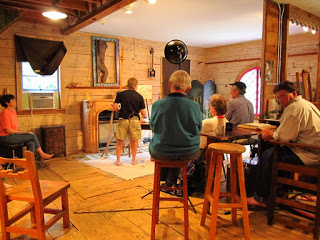
I saw a lot of improvement in this concept over the week. There were some very good painters in this workshop and I got them thinking outside of their comfort level. This is ALWAYS a good thing. On the last day, we had a three hour critique of the work that was done by everyone. You couldn't help but see the improvements from painting to painting. I was proud of them for taking risks and pushing themselves in new directions. They worked hard on the concepts I was teaching them and it showed.
One area that I push students to improve upon is 'composition'. Regardless of the level of skill, we can all work to improve on this aspect of painting. I admit that I am guilty of sometimes not giving enough thought to the composition of a painting before I begin. Oftentimes, the problem is this.. WE ARRIVE UPON A SCENE, WE GET ALL EXCITED BY IT AND WE CAN'T WAIT TO JUMP RIGHT INTO USING PAINT. As painters we love to paint. We love the feel of pushing all that paint around on a canvas. But...I am a firm believer that if we even take just five minutes to think about our plan before we jump in, we would all improve on our compositions. In one of my earlier posts, I talk more about composition. Here is a link to that post
'Painters Who Compose'
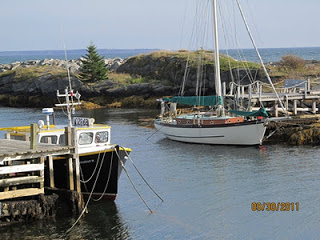 |
| No shortage of things to paint here! |
At the Lunenburg Art Gallery, where we held our last morning critique session, there was a retrospective show of work by
Earl Bailly. This remarkable painter, who developed polio as a child, rose above his handicap and painted by clenching a paintbrush in his teeth. This man knew how to compose a painting. It was a delight to look at the paintings on the gallery walls and talk about the artists knowledge of composition and to get the students talking about it. I saw light bulbs going off. It was a real eye opener to consider that each stroke on the canvas had been done while the artist held the paint brush in his mouth. The deftness of brush strokes to canvas were done with great sensitivity to the subject. Bold in some areas and soft and delicate in others. The handling of tree limbs in particular were most astonishing. I see so many painters, including myself, who can lose sight of how delicate a touch it takes to capture the essence of this subject. Here is a link to the
Gallery Show. This painting titled
'Winter Study' shows the handling and finesse of the tree limbs. The next time you feel like you've got it so hard, try to think about what this man overcame and maybe you will realize that your just not really looking at how good you've actually got it!
When the workshop was over, I spent one afternoon doing some painting on my own. Then the rain and gusty winds started coming in. There was a hurricane that was presently heading right for Nova Scotia and my plans to stay for an extra few days just to paint, were just not going to become a reality. Even if the hurricane were to miss Lunenburg, the forecast was calling for nothing but extremely heavy rain for three to five days. That night I said good bye to my host family and very early the next morning, I quietly left Lunenburg at 6:15 AM and drove towards the U.S. border in a pouring rain.
The rain was relentless. It became torrential at times and it was not a pleasant drive to say the least. I stopped a few times to take a break from driving and from the constant
swish swish of the windshield wiper blades. At one point, maybe an hours drive from the border, I napped in the car at a gas station. Then I grabbed some coffee and continued on my way. When I reached the United States, I was welcomed home with a smile by the officer at the border and I drove to a gas station in Maine, filled up and kept on driving.
I drove for a total of 14 hours that day. It rained the entire time too. The weather certainly made me have to drive slower and while a big part of me was preparing to keep on going the 3 or so hours until I reached home, the tired and sensible part of me, said enough is enough. It was dark now and I found myself a room, grabbed some dinner and went to bed. I let myself sleep in and did not get on the road until around 10 A.M. the next morning. I grabbed food and coffee at a McDonald's, wished myself a 'Happy Birthday' and turned left to get on the turnpike for home.
It rained the entire 3 hour drive home, which just seemed normal to me by now. When I pulled into my driveway, I suddenly remembered the duct tape 'fix' that I had used on the car sun-roof and I smiled to myself. My last minute idea with the tape had worked and was continuing to work. As of this writing, which is many weeks since the trip, the duct tape continues to hold strong.
Since Nova Scotia, I've taught a few weekend workshops while preparing for a new studio space. Pam and I are moving into a 1400 square foot studio which will become our 'home away from home' and will house ALL our things related to painting and teaching workshops. It is time for a change.
'Big Studio Space-Small Living Space'. It has become like a mantra for us. In the spring we will sell our house and find something tiny. The studio is absolutely awesome and Pam and I can't wait to officially move in for January 1st 2012.
For now I am posting a couple of images of the new studio. I promised in my last post to show pics of my demo's from Lunenburg, but I presently have all paintings and all work related 'THINGS' in storage as the studio gets the finishing touches done to it. We moved in just long enough to have our 'Open Studio' weekends there and for me to teach a weekend workshop on painting boats and harbors and then everything had to be put back into storage so that the floors could be done. I'll write more about the new studio and the concept of
'Big Studio Space-Small Living Space' in my next post!
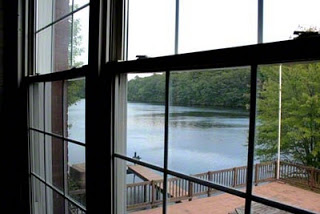 |
| A view from 'The Mill Works' |
 |
| 'Open Studio' before the floor was refinished and before track lights |
 |
| After 'Open Studio' with tracklighting up and floor refinished! |
 |
| There are five of these 8.5 ' x 11' windows! |